

When most homeowners start looking into renewable energy, they usually focus on the final results: drastically lower utility bills, increased home equity, and the peace of mind that comes with emergency battery backup. But to achieve those incredible results in the Pacific Northwest, a massive amount of high-level electrical engineering has to happen behind the scenes.
If you are a homeowner who loves to dig into the details, you have likely found yourself searching the internet for technical terms like “what is tilt angle of solar panels in Oregon” or “what is the SEF solar energy factor for Portland Oregon.” Unfortunately, if you ask an out-of-state door-to-door sales rep these questions, you will usually be met with a blank stare. The “solar bros” are trained in high-pressure sales scripts, not advanced photovoltaics or Oregon-specific weather patterns.
At Energy Solutions, we are proud to be energy geeks. As a premier licensed electrical contractor operating in the Portland Metro and Willamette Valley since 2013, our in-house licensed electricians and installers understand that your home is a complex electrical ecosystem.
Let’s take a deep dive into the technology and engineering that makes a solar array actually work in Oregon, separating the marketing fluff from the hard science.
The Geometry of Sunlight: What is the Optimal Tilt Angle?
One of the most common technical questions we get from engineers and researchers looking to go solar is about the physical placement of the glass: What is the optimal tilt angle of solar panels in Oregon?
To understand tilt angle, we have to look at our place on the globe. The Portland Metro sits at a latitude of roughly 45 degrees North. Because we are halfway between the equator and the North Pole, the sun does not pass directly overhead. Instead, it moves across the southern sky.
In the summer, the sun rides high in the sky. In the dark days of winter, the sun sits much lower on the horizon.
The “Perfect” Angle
In a perfect laboratory scenario, guided by baseline modeling from the National Renewable Energy Laboratory (NREL), the absolute best year-round tilt angle for a solar panel is typically close to your geographical latitude. Therefore, the mathematically “perfect” tilt angle for solar panels in Oregon is between 35 and 45 degrees.
- Summer Optimization: A flatter angle (around 15 to 25 degrees) catches more of the high summer sun.
- Winter Optimization: A steeper angle (around 45 to 60 degrees) is better at catching the low winter sun, and has the added benefit of easily shedding snow and heavy rain.
- The Year-Round Sweet Spot: A pitch of roughly 30 to 35 degrees provides the best blended average for year-round production in Oregon.
Real-World Roofs vs. “Perfect” Angles
If the perfect tilt angle is 35 degrees, do we build massive, ugly metal frames to tilt your panels perfectly on every roof? No.
For residential installations, we use a flush-mount system. We mount the panels parallel to your existing roof pitch. Most modern Oregon homes have a roof pitch between 4/12 (about 18 degrees) and 8/12 (about 34 degrees).
Here is the engineering secret: modern high-efficiency panels are so advanced that the difference in annual energy production between a “perfect” 35-degree tilt and a slightly flatter 20-degree flush-mounted roof is surprisingly small (often less than 5%). Flush-mounting is vastly superior because it is structurally more secure against high PNW winds, visually beautiful, and maintains the integrity of your roof.
(Note: If you have a completely flat roof or a Ground Mount system, our licensed installers will engineer the racking to hit that perfect 30 to 35-degree angle!)
Thermal vs. Photovoltaic: Understanding SEF in Portland
As you research solar technology, you might stumble across an older technical metric and wonder: What is the SEF (Solar Energy Factor) for Portland, Oregon? This is where the terminology gets tricky. SEF stands for Solar Energy Factor, and it is exclusively used to measure the efficiency of Solar Water Heating systems (the older technology that pumps liquid up to your roof to be heated by the sun), not Solar PV (Photovoltaic) systems that generate electricity.
In the past, homeowners looking to lower their water heating bills would install thermal solar tubes. To qualify for specific local cash incentives, like those distributed through the Energy Trust of Oregon, those thermal systems had to meet a specific baseline SEF rating.
The Modern Pivot: Heat Pump Water Heaters + Solar PV
Today, however, the technology has evolved. Installing complex liquid plumbing on your roof is largely considered outdated because it is prone to leaks and maintenance issues.
Instead of worrying about the SEF of a thermal system, the modern engineering standard is to install a Heat Pump Water Heater in your garage and power it with a Solar PV (Photovoltaic) system on your roof. Heat pump water heaters are incredibly efficient, and when you power them with the electricity generated by your roof, you achieve the exact same goal—free hot water—without ever running plumbing onto your shingles.
When you transition to Solar PV, the metric you need to focus on is no longer SEF; it is TSRF (Learn more about Total Solar Resource Fraction). This metric measures how much sunlight your roof actually receives and is closely monitored by organizations like the Oregon Department of Energy to determine eligibility for modern resilience and storage rebates.
The Heartbeat of the System: Microinverter Technology
Generating Direct Current (DC) power from the sun is only the first step. That power must be inverted into Alternating Current (AC) before your home’s electrical panel can use it. The technology you use for this process makes or breaks your system’s performance in Oregon.
Many out-of-state “solar bros” will quote you a system using a String Inverter. This is older technology where all the panels are wired together in a series like old Christmas tree lights. If a shadow from a Portland Douglas Fir falls across just one panel, the power output of the entire roof drops down to match the shaded panel.
At Energy Solutions, we demand better technology. We exclusively install premium Enphase Microinverters.
- Independent Processing: A microinverter is a highly advanced, tiny computer attached to the underside of every single panel.
- The Shade Advantage: If your chimney casts a shadow over one panel at 3:00 PM, only that single panel drops in production. The rest of the array keeps pumping out 100% capacity.
- No Single Point of Failure: If a central string inverter dies, your whole system goes down. With microinverters, if one unit ever needs servicing, the other 19 panels on your roof keep working perfectly.
This technology is non-negotiable in the tree-heavy Pacific Northwest. It is the only way to guarantee maximum energy yield.
The Climate Advantage: Why Oregon is Perfect for Solar
There is a persistent myth that solar panels require blistering heat to function. In reality, heat is the enemy of solar technology.
Solar panels operate using the Photovoltaic Effect, which reacts to UV light (photons), not ambient temperature. When solar panels get too hot—such as in the 115-degree summers of Arizona or Nevada—the electrical resistance inside the silicon cells increases, and the panels actually lose efficiency.
This is why Oregon is a surprisingly brilliant environment for solar engineering. Our cool, breezy, bright-overcast spring and summer days keep the panels operating at their absolute peak thermal efficiency. The panels run cooler, the voltage flows with less resistance, and the longevity of the equipment is significantly extended.
The Ultimate Technology: The Microgrid and Battery Storage
The final piece of the modern solar technology puzzle is grid-down resilience.
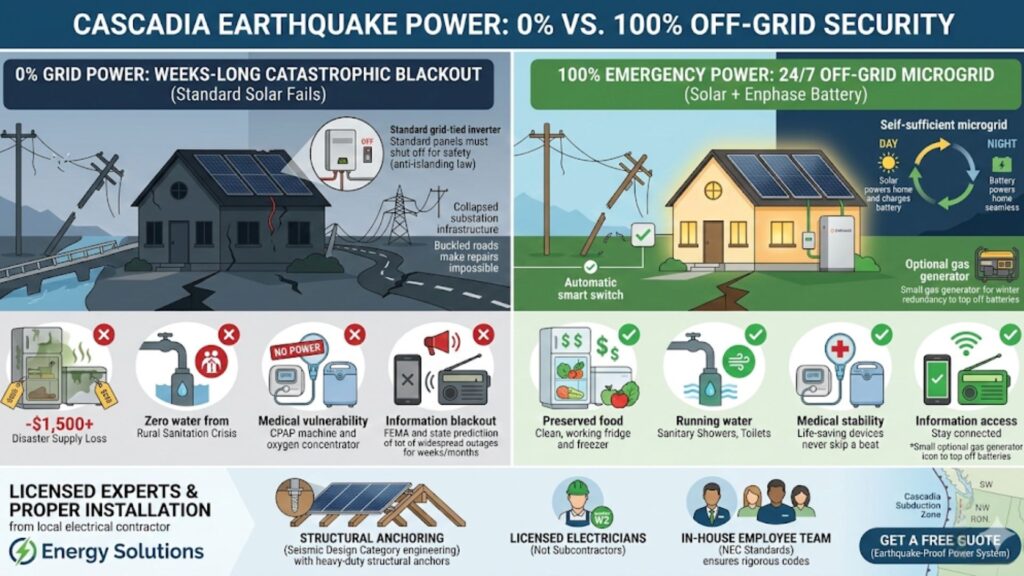
By law, standard grid-tied solar inverters must feature “anti-islanding” technology. This means if Portland General Electric (PGE) or Pacific Power loses the neighborhood grid due to an ice storm, your solar panels must shut off instantly. This protects linemen from being electrocuted by power flowing backward from your roof.
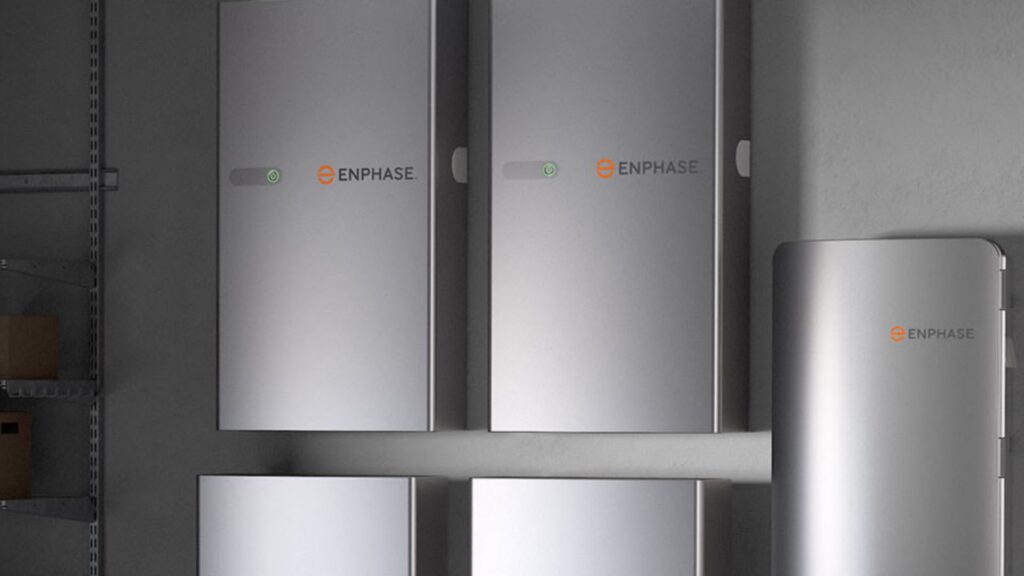
To bypass this and keep your lights on, we engineer an Enphase Energy Battery System. This transforms your home into a technologically advanced microgrid.
- The Smart Switch: The millisecond the grid voltage drops to zero, the Enphase IQ System Controller physically isolates your home from the dead utility grid.
- The Microgrid Creation: Because your home is safely isolated, the system “wakes up” your solar panels.
- Seamless Power: Your panels route DC power to the battery, the microinverters translate it to AC power, and your critical circuits (like your fridge, well pump, and furnace blower) continue to run without missing a beat.
This level of seamless, automated backup power is a technological marvel that was completely unavailable to residential homeowners just a decade ago.
The “Ecosystem” Rule: Engineering Requires Electricians
When you are dealing with optimal tilt angles, microinverter communication arrays, smart transfer switches, and high-voltage DC power, you are dealing with serious electrical engineering.
This is why you cannot trust your home to a marketing firm that subcontracts out to the lowest bidder.
At Energy Solutions, we operate by the Ecosystem Rule. We view your home as a complete, integrated electrical ecosystem. Our in-house licensed electricians and installers handle everything:
- Main Panel Upgrades: We ensure your home’s central nervous system can safely handle the new power load to strict National Electrical Code (NEC) standards.
- The Roofer Rule: Roofers are experts at roofing, not electricians. We respect your roof’s structural integrity, ensuring that racking attachments are perfectly flashed and bolted into the true structural rafters, not just the plywood decking.
- Permitting: We handle all the complex electrical and structural permitting with the state of Oregon.
Stop Guessing. Get the Hard Data for Your Home.
If you love the technology and want to see the exact engineering math for your specific property, don’t rely on generic online calculators or high-pressure sales pitches.
We will perform a comprehensive site audit, analyze your roof’s orientation, calculate your TSRF, and design a custom Enphase microinverter system tailored perfectly to your energy needs.
Get a Free Quote today and let our licensed Oregon electricians engineer your path to Energy Independence!
Your Next Steps for a Resilient Electrical Ecosystem
Taking the leap into renewable energy is a major decision, but you don’t have to navigate it alone. If you are ready to look at your specific home, we encourage you to explore our other resources:
- Learn how you can bank your summer sunshine to offset winter bills with Oregon Net Energy Metering.
- See if your home needs an Electrical Panel Upgrade to safely handle the new high-voltage loads.
- Discover how a Battery Backup system is the ultimate defense against Pacific Northwest grid failures and Cascadia earthquake threats.