

If you were one of the early adopters of residential solar in the Portland Metro area, SW Washington, or Clackamas County, first of all: thank you. You helped pave the way for a cleaner, more resilient grid in our local community. You saw the value of renewable energy before it was fully mainstream, and you’ve likely enjoyed years of drastically reduced electricity bills from PGE, Pacific Power, or Clark Public Utilities.
But as the Pacific Northwest climate continues to shift, bringing increasingly severe ice storms, high-wind events in the Gorge, and proactive summer wildfire shutoffs, we are hearing one critical question more than any other:
“I already have solar panels on my roof… is it possible to add a battery now?”
The short, definitive answer is yes. You absolutely can.
In fact, retrofitting battery storage to existing solar arrays is rapidly becoming the most requested service at Energy Solutions. However, integrating a massive high-voltage battery into your home isn’t just about plugging a box into the wall. As a premier local electrical contractor, we want to walk you through the “how” and “why” of battery retrofits so you can secure true energy independence.
The Problem: The “Solar Myth” and Grid Vulnerability
Let’s address the elephant in the room—a misconception that many national call-center “solar bros” fail to correct when they sell a system. Many homeowners mistakenly believe that because they have solar panels, their house will automatically remain powered when the neighborhood grid goes down.
Unfortunately, for 99% of standard grid-tied solar systems in Oregon and Washington, this simply isn’t true.
For critical safety reasons, your solar inverter is hard-coded to shut off the exact millisecond it detects a utility grid failure. This mandatory feature (known in the electrical code as “anti-islanding“) prevents your panels from sending high-voltage electricity backward onto the power lines while utility workers are out in the storm trying to repair them.
Without a battery, your solar panels are completely dormant during a blackout. Even if the sun is shining brilliantly over Mt. Hood on a freezing January afternoon, if PGE’s grid is down, your house is dark.
The Solution: True Local Electrical Expertise
At Energy Solutions, we do things differently. We aren’t a high-pressure sales team pushing generic solar packages. We utilize our in-house licensed electricians and installers to manage your entire project ecosystem. We can seamlessly integrate a modern Battery Backup system into your existing array, transforming your home into a fully independent micro-grid that safely operates during the worst Pacific Northwest storms.
The True Cost of a PNW Blackout (Why ROI Isn’t Everything)
When homeowners ask us about the benefits of adding a battery, they often start by asking about the “Return on Investment” (ROI). They want to know how many years it will take for the battery to pay for itself by storing excess summer solar power to use at night.
While maximizing your Net Energy Metering and using your own stored power daily is a fantastic financial benefit, the true value of a battery backup is not measured in daily utility savings. It is measured in disaster resilience.
Think back to the catastrophic January ice storms that routinely paralyze the Portland Metro area and SW Washington. Trees snap under the weight of an inch of solid ice, taking down primary transmission lines. In recent years, thousands of residents in places like Happy Valley, Lake Oswego, and Ridgefield have found themselves completely without power for five, seven, or even ten days.
When the grid collapses for an extended period, the financial and emotional costs skyrocket:
- The Frozen Pipe Catastrophe: If you lose power in 18-degree weather, your home’s internal temperature plummets. When water pipes freeze and burst, the resulting water damage can easily cost $15,000 to $30,000 to repair, not to mention months of living in a construction zone.
- The Food Spoilage Factor: A fully stocked family refrigerator and deep freezer easily contain $500 to $1,000 worth of groceries. After 48 hours without power, that food must be thrown directly into the garbage.
- The Rural Water Crisis: For our clients in rural Clark County or Clackamas County who rely on well water, no electricity means the well pump won’t run. No power means no flushing toilets, no showers, and no drinking water.
- The Hotel Scramble: When a house drops below 40 degrees indoors, families are forced to evacuate. Finding a pet-friendly hotel room that still has power during a regional emergency can cost $200+ per night—if you can even safely drive on the ice to get there.
When you factor in thousands of dollars in emergency plumbing repairs, spoiled food, hotel stays, and lost wages from the inability to work from home, a battery backup system essentially pays for itself during a single severe, multi-day winter disaster. It provides priceless peace of mind.
The Mechanics: How We Add Storage to Existing Panels
Many homeowners worry that adding a battery means ripping out their old system, replacing perfectly good inverters, or re-wiring the entire roof. Fortunately, that is rarely the case.
While brand-new installations often use “DC Coupling” (where the solar and battery share a single hybrid inverter), for retrofits, the gold standard used by our in-house licensed electricians is a method called AC Coupling.
What is AC Coupling?
In plain English, AC Coupling allows us to install a state-of-the-art battery system that sits securely alongside your current solar setup, rather than replacing it.
- Your Existing Panels: They keep doing their exact job. They convert sunlight into DC electricity, which your existing inverter (whether it’s an old string inverter or newer microinverters) converts to AC electricity for your home.
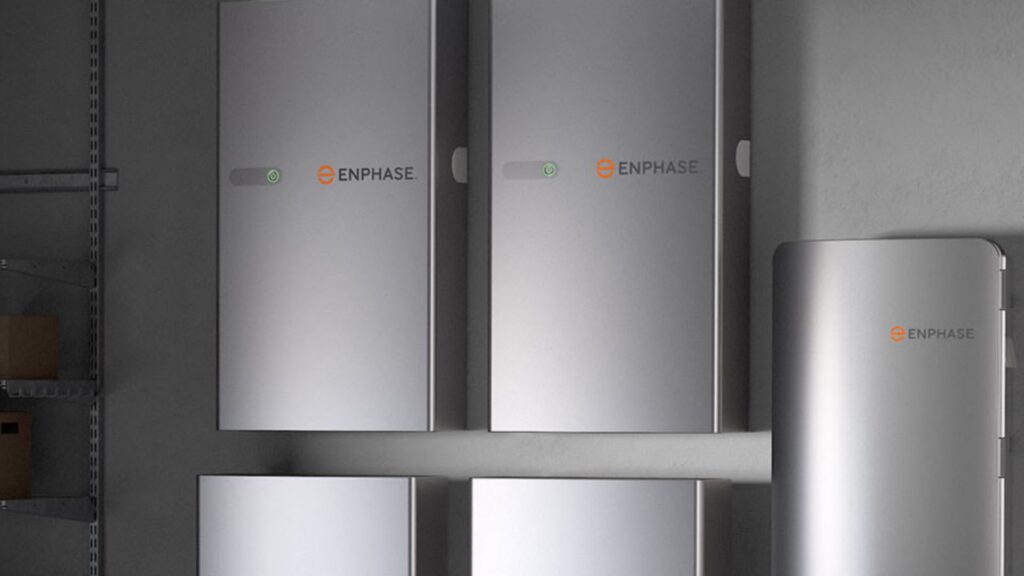
- The New Battery: We highly suggest and specialize in the Enphase Energy battery system. We install these advanced, smart battery units so they connect securely and directly to your main electrical panel.
- The “Smart Handshake”: When your solar panels produce more energy than your home is actively using, the new battery senses this excess and “gulps” it up, storing it for later.
What Happens the Second the Grid Fails?
Let’s paint a picture of how this actually looks during a real PNW winter storm. You are sitting in your living room, and a falling ice-covered branch takes out the neighborhood power lines.
- The Auto Transfer Switch: The Enphase Energy system includes an incredibly fast automatic transfer switch. Within fractions of a second of detecting the grid failure, this switch physically disconnects your house from the dead utility grid. It happens so fast that your lights won’t even flicker, and your microwave clock won’t reset.
- The App Alert: While the rest of your street is suddenly plunged into darkness, your home remains perfectly lit and warm. A moment later, your smartphone buzzes. You receive a message alert from your Enphase app notifying you: “Grid is down. Your home is now running on battery power.” 3. The Micro-Grid: Because the auto transfer switch safely isolated your home from the neighborhood grid, your solar panels are allowed to stay on. They continue to power your house, and any extra sunshine goes straight into recharging the battery for the night ahead.
This approach is universally compatible. Whether your system was installed in 2016 by a company that has since gone out of business, or you have a modern array, our team can safely integrate an AC-coupled battery without disturbing your existing roof setup.
The Neighborly Expert Tip: When contemplating any major electrical upgrades to your home, remember the Golden Rule of contractors: Roofers are experts at roofing, not electricians. Sometimes homeowners ask if a roofing crew can handle solar removals or battery tie-ins while they are up there doing repairs. Never allow an unlicensed worker to touch your high-voltage power plant. Always rely on our in-house licensed electricians and installers to ensure your home is safe, properly permitted, and up to code.
What Can I Power During an Outage?
One of the most important parts of our local consultation process is helping you determine what you actually need to keep running during an ice storm. This dictates the size, capacity, and cost of the battery system. We generally design systems in one of two ways:
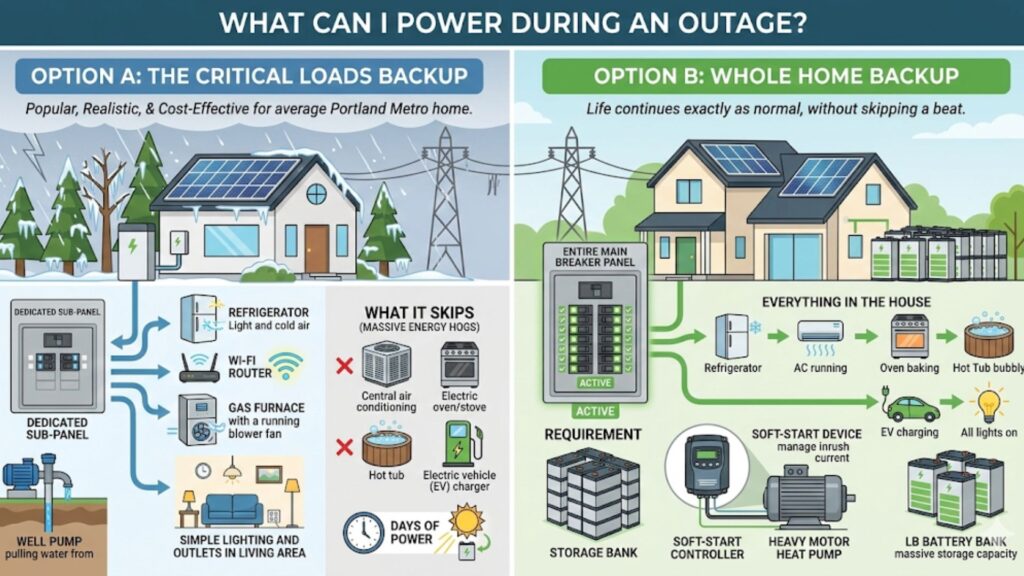
Option A: The Critical Loads Backup
This is the most popular, realistic, and cost-effective option for the average Portland Metro home. We install a dedicated “sub-panel” that isolates only your most vital circuits.
- What it covers: Your refrigerator, the Wi-Fi router, the blower fan for your gas furnace (crucial for winter heating), your well pump, and the lighting and outlets in your main living areas.
- What it skips: The massive energy hogs. We purposefully leave off the central air conditioning, the electric oven, the hot tub, and the EV charger.
- The Benefit: By managing your power strictly, a moderately sized battery can keep your family safe, warm, and connected for days, constantly recharging from the sun each afternoon.
Option B: Whole Home Backup
For homeowners who want life to continue exactly as normal without skipping a beat, we design systems to back up the entire main breaker panel.
- What it covers: Everything in the house, up to the maximum output rating of the battery bank.
- The Requirement: This requires multiple stacked battery units for massive storage capacity. It also typically involves our electricians installing “soft-start” devices on heavy motors (like a 4-ton heat pump) to prevent them from draining the battery too quickly when they cycle on.
Maximizing the Value: Signature Packages and Tax Credits
Because we manage the entire electrical ecosystem of your home, many homeowners choose to bundle a battery retrofit with other necessary upgrades to save significantly on long-term labor costs. Our licensed team is already pulling permits and opening up your electrical panel—it is the perfect time to optimize your home.
The Resilient Home Package
If absolute disaster preparedness is your goal, we can upgrade your home into a fortress of energy independence. This package integrates your existing solar array with a new Battery Backup system, and we can even add a manual transfer switch for a portable or standby generator. If an ice storm covers your solar panels in a thick layer of frost and the battery begins to run low after three days, you have a tertiary layer of backup power ready to go.
The Financial Incentives
While the disaster resilience of a battery is priceless, the financial incentives available right now make the upfront investment highly attractive.
The Federal Government recently updated the tax code to heavily incentivize grid resilience. Homeowners can now claim the 30% Federal Investment Tax Credit (ITC) on standalone battery storage.
This means that if you add a battery to your home today, you can claim 30% of the total project cost (equipment and our licensed labor) as a credit against your federal income taxes. You do not need to install new solar panels to qualify; retrofitting an old system is fully eligible. (For the exact IRS details and eligibility requirements, we always recommend reviewing the Department of Energy’s Homeowner Guide to the Federal Tax Credit or speaking with your CPA).
Ready to Secure Your Power Supply?
Your original solar panels were a fantastic first step. They lowered your carbon footprint and saved you thousands on utility bills over the years. But adding a battery is the definitive step that transforms that financial investment into a true, 24/7 lifeline. It changes your home from a passive consumer of grid electricity into an active, resilient, and independent energy hub.
Don’t wait until the meteorologists start predicting the next major Gorge wind event or Willamette Valley ice storm. Battery permitting and interconnection with local utilities takes time, and you want your system fully commissioned before the severe weather arrives.
If you are curious about how an Enphase battery would fit with your specific existing setup, let’s have a conversation. No high-pressure tactics, no out-of-state call centers. Just a neighborly look at your current solar equipment, your home’s electrical panel, and your family’s safety goals for the future.
Get a Free Quote today and let our local experts design your path to complete Energy Independence!