

Have you ever stood outside on a surprisingly sunny Portland afternoon in February, felt the warmth on your skin, and thought about the sheer power of the sun? Even here in the Pacific Northwest, where we are famous for our rain, the sun provides an incredible, constant source of energy.
For many homeowners in NW Oregon and SW Washington, harnessing that power feels like complex science fiction. You see the sleek black glass on your neighbor’s roof in Lake Oswego or Vancouver, but the actual mechanics of how that glass powers a refrigerator or charges an electric vehicle remains a mystery.
At Energy Solutions, we believe that achieving Energy Independence shouldn’t require a degree in advanced physics or electrical engineering. As a premier licensed electrical contractor founded in 2013, we’ve helped over 1,050 of your neighbors make the switch to clean, renewable energy. Our goal isn’t just to sell you equipment; it’s to act as your local, neighborly guide, demystifying the technology so you can make a confident, informed decision about your home’s future.
This guide is designed to be a simple, jargon-free explanation of how solar panels actually work in the Pacific Northwest—breaking down exactly what happens from the moment sunlight leaves the sky to the moment it powers your morning coffee maker.
Part 1: From Sunbeam to Socket (The Magic Inside the Panel)
At the absolute heart of every solar energy system we install are the panels themselves. But when you look at those sleek, black rectangles bolted to a roof, what are they actually doing?
In short: their entire job is converting sunlight directly into electricity. The science behind this seemingly magical transformation is a fascinating physical process called the Photovoltaic Effect.
Here is the “Photovoltaic Effect for Beginners” explanation:
Imagine a single solar cell inside your panel is built like a microscopic sandwich. The “bread” slices of this sandwich are made of silicon, which is a highly conductive element (and actually one of the most common elements on Earth, found in sand). To make this silicon sandwich generate power, scientists treat each slice slightly differently:
- The N-type Layer (The Top Slice): This layer is chemically treated with phosphorus to give it an abundance of extra electrons. Because electrons carry a negative charge, this top layer becomes negatively charged (N-type).
- The P-type Layer (The Bottom Slice): This layer is treated with boron to create “holes” or spaces missing an electron. This gives the bottom layer a positive charge (P-type).
When these two oppositely charged slices are pressed together inside the factory, they create a permanent electric field—much like the positive and negative terminals of a standard AA battery.
Now, here comes the sun.
Sunlight isn’t just a beam of light; it is made up of billions of tiny, invisible packets of pure energy called photons. When these high-energy photons travel 93 million miles and strike the top surface of your solar panel, they hit the silicon like billiard balls. This impact knocks the extra electrons in the top layer completely loose from their atoms.
Because of the electric field built into the silicon sandwich, those loose, negatively charged electrons are forced to flow in one specific, organized direction to find a “hole” in the bottom layer. We capture that organized flow of electrons with tiny metal wires built into the panel.
That flow of electrons is electricity! Specifically, it is Direct Current (DC) electricity. So, when someone asks you how solar panels work, the simplest neighborly answer is: They capture tiny packets of sunlight to create a flow of electrons right on your roof.

Part 2: The Inverter (Translating the Power)
Generating DC electricity on your roof is a brilliant first step, but there is a major catch: your home, your appliances, and the entire regional utility grid run on Alternating Current (AC) electricity.
If you plugged your television directly into a solar panel, it wouldn’t work. The power has to be “translated” first. This is where the most critical (and often overlooked) component of a solar system comes into play: The Inverter.
At Energy Solutions, we frequently see out-of-state “solar bros” quote homeowners with outdated “string inverters.” In a string inverter system, all the panels on your roof are wired together in one big chain, and they send all their DC power down to one central box on the side of your house to be converted to AC.
Why is this a terrible idea in Oregon? Because we live in a region defined by massive trees. If a shadow from a 100-foot Douglas Fir falls across just one panel in a string inverter system, the power output of the entire roof drops down to match the shaded panel. It’s like a kink in a garden hose.
Because we are licensed electrical contractors, we demand better engineering for your home. We specialize in using top-tier Enphase Microinverters.
Instead of one central box, a microinverter is a tiny, highly advanced computer attached to the underside of every single panel on your roof. It converts the DC to AC electricity right there on the spot. If your chimney or a nearby tree casts a shadow over one panel at 3:00 PM, only that single panel drops in production. The rest of the array keeps humming along at 100% capacity. In the tree-heavy neighborhoods of West Linn, Oregon City, and SW Washington, microinverters are absolutely mandatory to get the fastest payback on your investment.
Part 3: The Flow of Power (How Your Home Uses the Sun)
Once the Enphase microinverters have translated the sunlight into usable AC electricity, that power travels down conduit pipes from your roof directly into your home’s main electrical panel.
This is where the true beauty of a solar ecosystem happens:
1. Your Home Gets “First Dibs”
The electricity generated by your roof follows the path of least resistance. The moment the solar power hits your electrical panel, your home instantly consumes it to power whatever is currently running. If you are doing laundry, watching TV, and running a heat pump, those appliances will suck up the solar power directly.
2. The Magic of Net Energy Metering
But what happens on a bright July afternoon in Clackamas County when nobody is home? Your 20-panel array is pumping out massive amounts of electricity, but your house is only using a tiny fraction to keep the refrigerator cold.
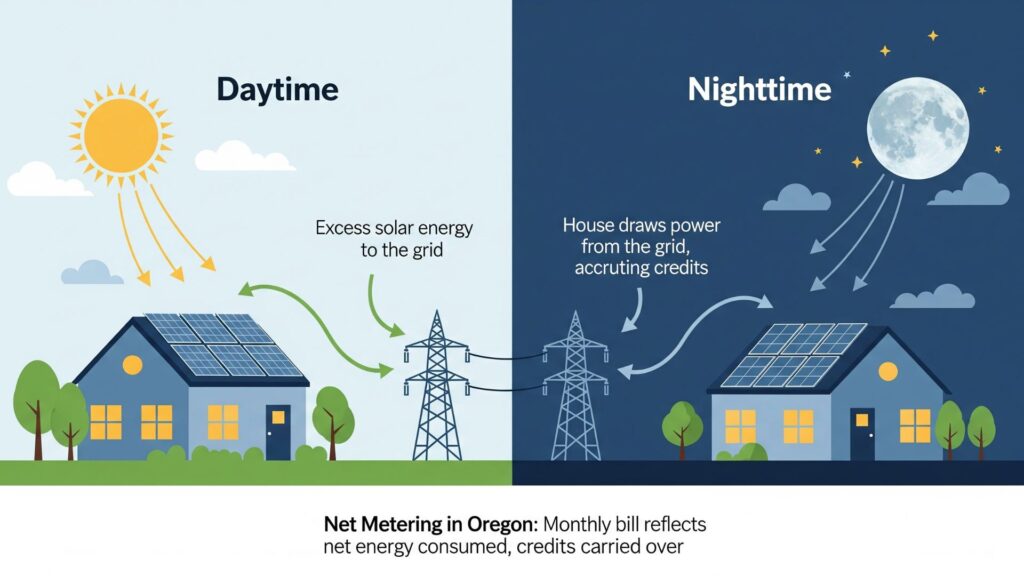
This excess energy does not go to waste. Instead, it flows backward out of your electrical panel, through your utility meter, and out onto the neighborhood grid. This triggers a program called Oregon Net Energy Metering (NEM).
Think of the regional grid (PGE, Pacific Power, or Clark Public Utilities) as a giant, invisible battery. When you send your excess summer power back to them, your utility meter physically spins backward. The utility company legally must give you a 1-for-1 retail credit for that energy.
3. Drawing Power at Night
When the sun goes down, your panels naturally go to sleep. At this point, your home seamlessly transitions back to drawing electricity from the grid. You won’t notice a flicker of the lights. Because you “banked” so many credits during the sunny afternoon, the power you use to watch movies and run the dishwasher at night is essentially paid for by the sun you generated hours earlier. You can literally bank summer sunshine to pay for your dark, winter heating bills.
Part 4: The “Rainy PNW” Myth
Because we live in the Pacific Northwest, we inevitably hear the same concern at nearly every kitchen table consultation: “Does solar actually work with all the rain and clouds in Oregon?”
Yes. Absolutely. The biggest myth in the solar industry is that panels need scorching heat and direct, blinding sun to work. In reality, solar panels run on UV light, not heat. In fact, extreme heat (like a 115-degree day in Arizona) can actually cause solar cells to overheat and lose efficiency. Our cool, breezy, bright-overcast climate in the PNW is actually an incredibly healthy environment for solar electronics.
While production is naturally lower on a rainy Tuesday in December than it is in July, your system is still actively capturing ambient UV light and trickling power into your home. When our engineers design your system, we don’t guess; we use 12 months of localized historical weather data to ensure your custom array is perfectly sized to offset your annual usage.
Part 5: The Grid-Down Caveat (And the Disaster ROI)
If the sun powers my house, what happens during an outage?
This is a critical truth that aggressive sales teams often omit: If the utility grid goes down due to an ice storm or a transformer failure, a standard solar system without a battery will automatically shut down, too. This is a mandatory safety feature. If utility workers are climbing the poles on your street to fix a downed line, your solar panels cannot be pumping high-voltage electricity backward into the grid. It would be fatal.
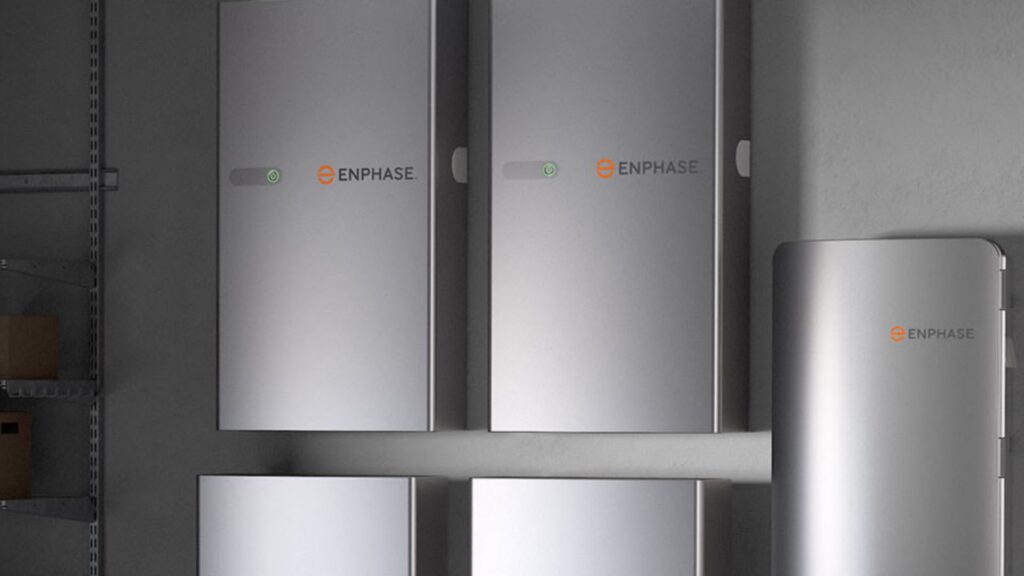
To achieve true resilience, you must decouple from the grid using an Enphase Energy battery system. When the grid fails, the battery’s smart switch instantly detects the outage and “islands” your home. Your panels stay on, routing power to your battery and keeping your critical circuits running while the neighborhood goes dark.
Rethinking the “ROI” of a Battery
Homeowners often ask how long it takes a battery to “pay for itself” in daily utility savings. But we encourage you to reframe this calculation. The true value of a battery is not measured in daily cents; it is measured in disaster resilience.
What is the cost of energy when you cannot get it for a week?
- The $15,000 Burst Pipe: Your furnace blower dies during a freeze. Your home drops below 32 degrees, pipes burst, and you face massive water damage repairs and insurance deductibles.
- The $1,000 Grocery Loss: A fully stocked fridge and freezer spoil after 48 hours without power.
- The Well Pump Crisis: For rural homes, no electricity means no water for drinking, flushing toilets, or bathing, forcing expensive emergency hotel stays.
When the grid is off for days, a battery backup system essentially pays for itself by preventing catastrophic property damage and providing a service money cannot buy: absolute safety.
Part 6: Why Choosing a Licensed Ecosystem Matters
When you decide to transition your home to solar power, you aren’t just buying a household appliance; you are fundamentally altering your home’s high-voltage electrical infrastructure.
This brings us to the most important advice we can give Oregon homeowners: The “Ecosystem” Rule.
Most online “solar companies” are actually just marketing firms. They run Facebook ads, sell you a one-size-fits-all contract, and then hire out the labor to the cheapest possible subcontractors. They treat solar like slapping stickers on a roof.
At Energy Solutions, we are Licensed Electrical Contractors. We utilize our in-house licensed electricians and installers to manage the entire ecosystem of your project.
- The Audit: We physically evaluate your roof structure, your shading, and the capacity of your main electrical panel to see if it needs an upgrade.
- The Engineering: We custom-design a system to maximize your specific roof layout.
- The Permitting: We handle all the complex bureaucratic red tape with Oregon City, Portland, or Clark County.
- The Install: Our own highly trained W2 employees perform the work to strict National Electrical Code (NEC) standards.
The “Roofer” Rule
Finally, never let a generic solar salesperson pressure you into installing panels on a 15-year-old roof.
Remember: Roofers are experts at roofing, not electricians. If your roof is nearing the end of its life, we will honestly advise you to replace it before we install a 30-year power plant on top of it. If you need a re-roof down the line, we offer a dedicated solar panel remove and reinstall service where our licensed electricians will safely remove and reinstall your array, protecting both your roof warranty and your home’s safety. Never let an unlicensed roofing crew unbolt your high-voltage solar panels!
Ready to Take Control of Your Energy?
Understanding how solar panels work is the first step toward true Energy Independence. Solar is a straightforward, reliable, and incredibly durable technology that empowers homeowners to take absolute control of their long-term utility costs and their family’s safety.
But the best system is the one engineered specifically for your home’s unique layout and your family’s specific energy habits. With over 1,050 successful local installations, Energy Solutions is the Portland Metro’s definitive authority on residential energy ecosystems.
Don’t settle for high-pressure sales pitches or generic satellite estimates. We invite you to find out exactly what the sun can do for your specific property.
Get a Free Quote today and let our local, licensed experts design a customized energy solution for your home!